
An estimated 72% of customers prefer that companies communicate with them by email. With this in mind, does your segmentation process have any holes?
Ensure your emails are reaching the right audiences.
It may be a slight surprise that when asked how they prefer companies talk to them, the number one choice for customers was email—across all demographics (except women ages 65+ who prefer postal mail and email). That’s according to a MarketingSherpa survey conducted earlier this year.
Email is clearly still important to customers. Fortunately, many companies today have a solid email strategy, including tactics such as segmentation. Unfortunately, we see some common segmentation mistakes as a technology marketing firm.
Before we drill into mistakes, let’s look at a success story.
Ferguson Enterprises is an $11B plumbing and PVF distributor. At Email Summit 2015, the Ferguson Email Specialist shared how refining their e-mail process created a significant lift in online sales. Segmentation played a big role. A “one-click wonder” campaign was a key first step in segmentation. Here’s how it worked:
After Ferguson learned they have about 14 different types of customers, they sent an email to their list asking people to identify who they are–in just one click. The email was short and visual. The result? This campaign, combined with other efforts, increased Ferguson’s segmentation population from 52% to 67%. The company also produced an 81% lift in effectiveness from preference-centric emails.
This case study hits home for me. A few years ago, I purchased more than $25K in supplies from Ferguson when I built a new home. My influencers for this decision included a contractor, plumber, architect and interior designer. These are now a few of Ferguson’s audience segments. From a homeowner and marketer perspective, I definitely see the value of Ferguson’s approach.
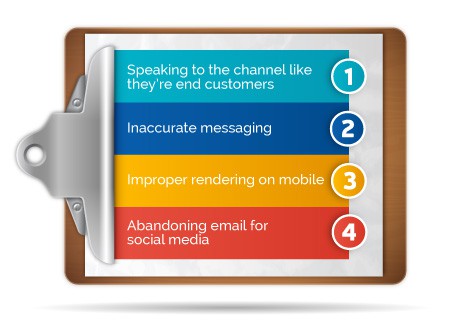
Although numerous companies in the technology marketing space are using email segmentation, here are four common mistakes we see big brands make:
- Speaking to the channel like they’re end customers. End customers and channel partners have different needs and, while their goals align in many areas, there are also areas where they don’t.
Inaccurate messaging. Be aware of potentially-problematic messaging, such as geo-targeted communications (unless you’ve reviewed targeting and messaging accuracy). For example, many customers in the Southwest who aren’t big fans of summer heat can’t relate to emails sent by Northeast companies that wish away snowy winter for the sunny season.
Improper rendering on mobile. Test, test, test—across mobile devices and different versions to ensure this critical audience can actually see and engage with your emails as intended.
Abandoning email for social media. Don’t completely ditch your email strategy in favor of newer channels like social media without proper analysis. You might want to explore options such as LinkedIn’s Inmail but don’t abandon what has provided some success for the shiny new penny. Channel diversification is key. (By the way, according to MarketingSherpa’s survey, social media only ranked sixth on the list of customers’ communication preferences.)
Why do holes like these happen? Oftentimes, there’s a strong technical person/team in tech-savvy corporations to make the email process work. However, the marketing eye is missing. A marketer can catch communication gaps as well as spot opportunities. That’s why you need both technical and marketing skillsets on your email team.
In many cases, we’ve seen how marketing automation systems such as Eloqua, Marketo, Pardot or Silverpop not only improve email efficiency but re-energize marketing, sales and technical teams.
To catch the highlights of Email Summit 2015 (and case studies by Ferguson, Microsoft Store, Finish Line, Kentucky Derby and CNET), visit MarketingSherpa. This 30-minute webinar is a good refresher and reminds us technology marketers that e-mail is not dead yet.