
My nephew has a DSLR that shoots 4K, so why should we pay a premium for professional corporate video production? It’s a question we hear a lot, and it’s a fair one. The democratization of video technology means that high-quality cameras are more accessible than ever before. But while a modern DSLR is a powerful and capable tool, it’s not designed for the specific and rigorous demands of professional video.
At Binary Pulse Studios, a Southern California based production company, we believe in the right tool for the job. Our Director of Photography, a seasoned artist and technician, understands that a great camera is an extension of a creative vision.
The DSLR: A Jack-of-All-Trades
Let’s start by giving credit where it’s due. The rise of the DSLR (and its mirrorless counterparts) has been a game-changer. These cameras are affordable, portable, and capable of producing stunning still images and very good video. They’re fantastic for travel vlogs, family events, and some social media content. For a small business owner looking to create quick content, a high-end DSLR can be a great starting point.
However, a DSLR is fundamentally a still camera with video capabilities bolted on. This becomes evident when you push it to its limits on a professional set. Their small, often plastic bodies are difficult to rig with professional accessories like matte boxes and follow focuses. Crucially, they’re not designed for long-form shooting. Due to thermal limitations, most DSLRs can only record for a maximum of 30 minutes, a massive handicap for interviews, conferences, or live event coverage.
Furthermore, the video files they produce are highly compressed and typically limited to an 8-bit color depth. This means the camera captures a more limited range of colors and tonal information. While the footage may look fine straight out of the camera, it offers very little flexibility in post-production, making it difficult to achieve a polished, color-graded look that truly stands out.

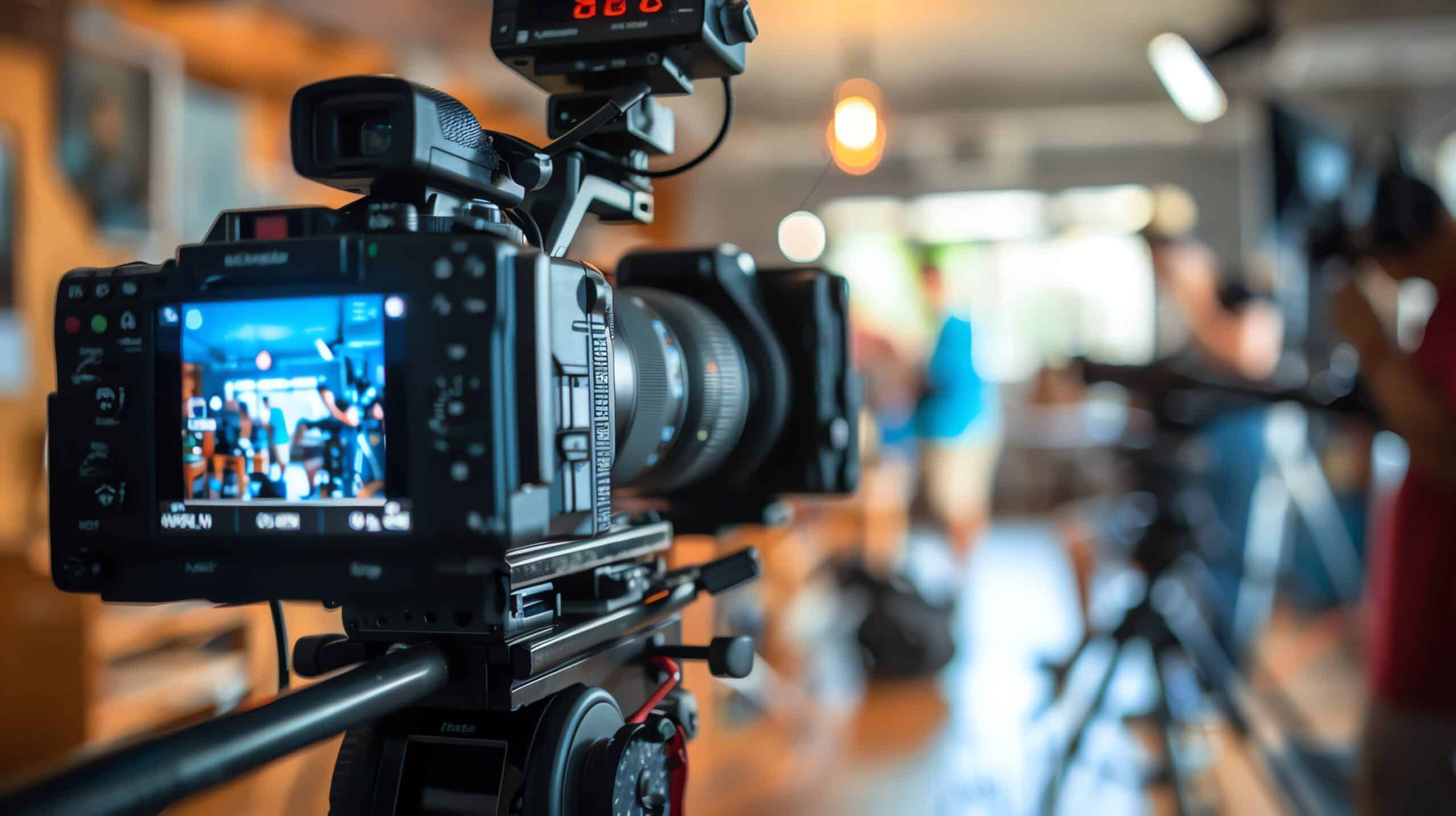
The Cinema Camera: A Purpose-Built Machine for Professional Corporate Video Production company
When we talk about professional-grade cameras—think an ARRI ALEXA, a RED, or a Canon C500—we’re talking about machines purpose-built for the craft of filmmaking. This isn’t just an incremental step up; it’s a paradigm shift in capability and quality. The distinction is one are that sets our corporate video production apart.
Superior Image Quality
This is where the difference becomes undeniable. Cinema cameras are designed with larger sensors that capture a much wider dynamic range. This is the camera’s ability to capture detail in both the brightest and darkest parts of a scene. A DSLR might blow out the sky to properly expose your subject, leaving you with a white blob. A professional cinema camera, with its 13-16 stops of dynamic range, can hold onto the detail in the clouds while still perfectly exposing the person in the foreground. This provides a rich, cinematic look that is simply impossible to achieve with a prosumer camera.
Just as critical is color science and bit depth. While a DSLR captures color in 8-bit, giving it access to just over 16 million colors, a professional cinema camera often records in 10-bit, 12-bit, or even higher. A 10-bit image has over a billion colors. Think of it like this: an 8-bit image is a box of 256 crayons, while a 10-bit image is a billion-crayon box. This incredible difference allows for subtle, smooth color gradients and gives our colorist the ability to perfectly match your brand colors and create a final product that looks slick and professional, not just “good.”
High-End Codecs and Workflow
Professional cameras record in less-compressed, high-data-rate codecs like ProRes, or even uncompressed RAW formats. These massive files retain an incredible amount of information, which is a dream for our editing and color grading team. It allows us to push and pull the image without it falling apart. While a DSLR’s highly compressed H.264 file might be easy to store, it’s far less forgiving in post-production, often showing compression artifacts and posterization when you try to manipulate the color. This is a crucial distinction for high-quality corporate video production.
Beyond the Image: The Production Advantages
The benefits of a cinema camera extend far beyond the pixels on the screen. They are built to be part of a seamless, efficient, and reliable production ecosystem.
Unmatched Ergonomics and Reliability
A professional camera is built to be a workhorse. Its robust body and built-in cooling systems allow for continuous recording, which is essential for uninterrupted interviews or long event coverage. Its design allows it to be rigged easily with professional tools, from matte boxes to external monitors, which our DP uses to perfectly craft every shot.
Seamless Audio Integration
Have you ever seen a corporate video with great visuals but terrible audio? You won’t get that with us. A professional camera features professional XLR audio inputs. This allows us to plug in high-quality boom mics and lavalier microphones directly into the camera, capturing broadcast-quality audio that is perfectly in sync with the video. This saves massive amounts of time in post-production, as we don’t have to sync separate audio tracks.
Professional Connectivity
Cinema cameras are equipped with professional-grade ports like SDI and timecode. This is crucial for multi-camera setups, ensuring every camera is perfectly synchronized. This not only streamlines the editing process but guarantees a flawless final product for your corporate video production project.
The Human Element: Talent is the Ultimate Tool
A great camera is nothing without the talent behind it. Our Director of Photography and cinematographers are masters of their craft, and their choice of camera is a deliberate act of creative and technical control. They understand how to leverage the dynamic range to create cinematic lighting, use the color depth to make your brand colors pop, and rely on the camera’s rugged reliability to capture every crucial moment without fail.
The investment in professional equipment is a commitment to a higher standard. It means your corporate video production will not just look good—it will look exceptional. The final product will have the polished, cinematic aesthetic that will stand out from the crowd, reflect the high value of your brand, and deliver a better return on your investment.
When you’re ready to elevate your brand’s story, let’s talk about how the right tools, and the right team, can make all the difference.